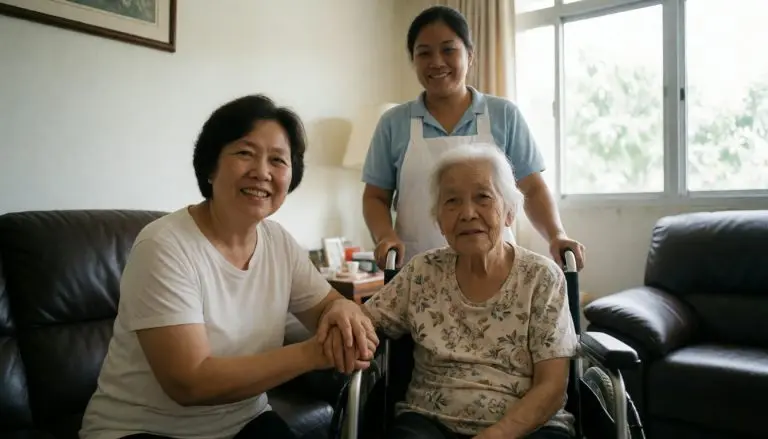
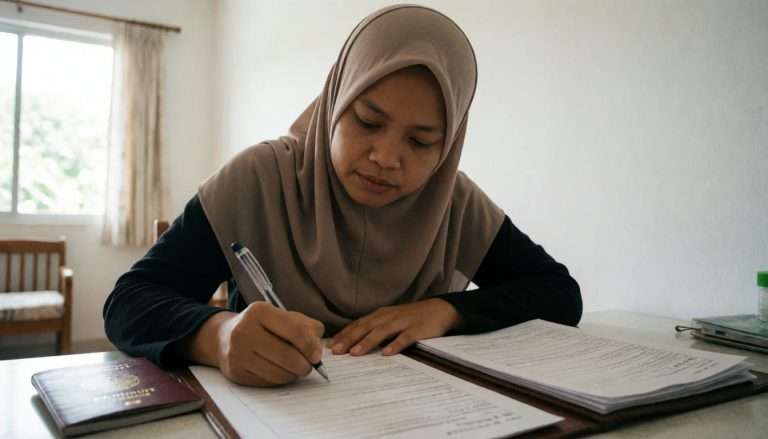
Caring for a parent or family member at home costs money: a helper, home care, transport, medical supplies. The Home Caregiving Grant (HCG) gives families a monthly cash payment to help with those costs, and you can use it towards hiring a helper.
This guide explains how much you can get, who qualifies, how to apply, and how it works together with the other schemes for families with a helper. All facts are from the Agency for Integrated Care (AIC), which runs the grant (AIC: Home Caregiving Grant).
How much is the Home Caregiving Grant?
The grant is paid every month. The amount depends on your household’s monthly income per person:
- S$600 a month: household income per person of S$1,500 or less (or, for households with no income, a home with an Annual Value of S$21,000 or less)
- S$400 a month: household income per person of S$1,501 to S$3,600
- S$200 a month: household income per person of S$3,601 to S$4,800
Households that own more than one property get the S$200 tier.
How “income per person” works: add up the gross monthly income of everyone in the household (salary, self-employed income, overtime, allowances, commissions and bonuses) and divide by the number of people in the household. The household is the people living at the care recipient’s NRIC address.
Example: a household of 4 earning S$9,000 a month in total has an income per person of S$2,250, so it gets S$400 a month.
Who qualifies?
The person being cared for (the care recipient) must:
- be a Singapore Citizen, or a PR with a parent, child or spouse who is a Singapore Citizen
- live in Singapore, at home, not in a nursing home, chronic sick hospital or inpatient hospice
- permanently need help with at least 3 of the 6 activities of daily living, confirmed by a disability assessment
- be in a household with income per person of S$4,800 or less (or, with no household income, a home Annual Value under S$21,000)
There is no minimum age. The grant is not only for the elderly: it also covers younger people with disabilities. For someone under 21, a parent or legal guardian applies.
The 6 activities of daily living (ADLs)
The usual list is: washing or bathing, dressing, feeding, toileting, walking or moving around, and transferring (for example, from bed to chair). The care recipient must permanently need help with at least 3.
The disability assessment
The need for help is confirmed with a Functional Assessment Report (FAR) from a GP or other approved professional (for intellectual disability or autism, an MSF-approved Client Assessment Form instead). Any fee for the assessment is paid by the family.
You don’t need a separate assessment if the care recipient is applying for or already receives certain severe disability schemes, such as CareShield Life, ElderShield, ElderFund or IDAPE.
How to apply
- Get the disability assessment done, unless you’re exempt (see above).
- Apply online through AIC’s e-Services for Financing Schemes (eFASS) with Singpass. AIC says online applications are approved faster.
- Or apply on paper: email [email protected] or visit an AIC Link.
Processing can take up to 4 weeks, and the outcome is sent by post.
How the grant is paid
- Into the bank account you nominate, usually from the month after approval (it may include the month you applied).
- It shows on your bank statement as “HCG”.
AIC warns that wrong information about its schemes circulates online. Check details on AIC’s website or call AIC on 1800-650-6060. AIC will never ask for bank details or money transfers over the phone.
Using the grant to hire a helper
AIC lists hiring a helper among the care costs the grant can go towards. For many families, the grant plus the lower levy makes a live-in helper affordable:
1. The S$60 levy concession
If the person you care for lives with you and is aged 67 or above (Singapore Citizen), or is a person with disabilities who needs help with at least one daily activity (with an AIC recommendation letter), your helper’s levy drops from S$300 to S$60 a month (MOM: levy concession). More in maid levy rates, GIRO and waivers.
2. The Caregivers Training Grant
Your helper can take approved caregiving courses paid by the Caregivers Training Grant: S$400 in the first year, then up to S$200 added each 1 April, capped at S$400 (AIC: Caregivers Training Grant).
Putting it together: an example
A family caring for an 80-year-old mother who needs help with bathing, dressing and walking, with household income of S$2,000 per person:
- Home Caregiving Grant: S$400 a month
- Levy: S$60 instead of S$300, a saving of S$240 a month
- Caregiving courses for the helper: paid from the Caregivers Training Grant (minimum S$10 co-payment per course)
That’s S$640 a month of support towards the cost of a helper.
Our guide to hiring a helper for elderly parents covers what to look for in an eldercare helper and what to ask in the interview. You can browse helpers with elderly care experience, or post your job free and let helpers apply.
Frequently Asked Questions
How much is the Home Caregiving Grant?
S$600, S$400 or S$200 a month, depending on your household’s monthly income per person (S$1,500 or less, S$1,501 to S$3,600, or S$3,601 to S$4,800). Owners of more than one property get S$200.
Who is eligible for the Home Caregiving Grant?
A Singapore Citizen (or a PR with a citizen parent, child or spouse) living at home in Singapore, who permanently needs help with at least 3 of the 6 activities of daily living, in a household with income per person of S$4,800 or less.
Can I use the Home Caregiving Grant to pay for a maid?
Yes. AIC lists hiring a helper among the care costs the grant can be used for. You can also get the S$60 levy concession if the person you care for is 67 or older or has a disability.
Is there an age limit for the Home Caregiving Grant?
No minimum age. It covers anyone who meets the care needs and income criteria, including younger people with disabilities.
How do I apply for the Home Caregiving Grant?
Online through AIC’s eFASS with Singpass, or by email to [email protected] or at an AIC Link. You need a disability assessment first unless you’re on certain severe disability schemes.
How long does it take to get the Home Caregiving Grant?
Processing can take up to 4 weeks. Payments usually start the month after approval.


 English
 Indonesian
 Myanmar
 Leonard Ng | Updated: November 18, 2026